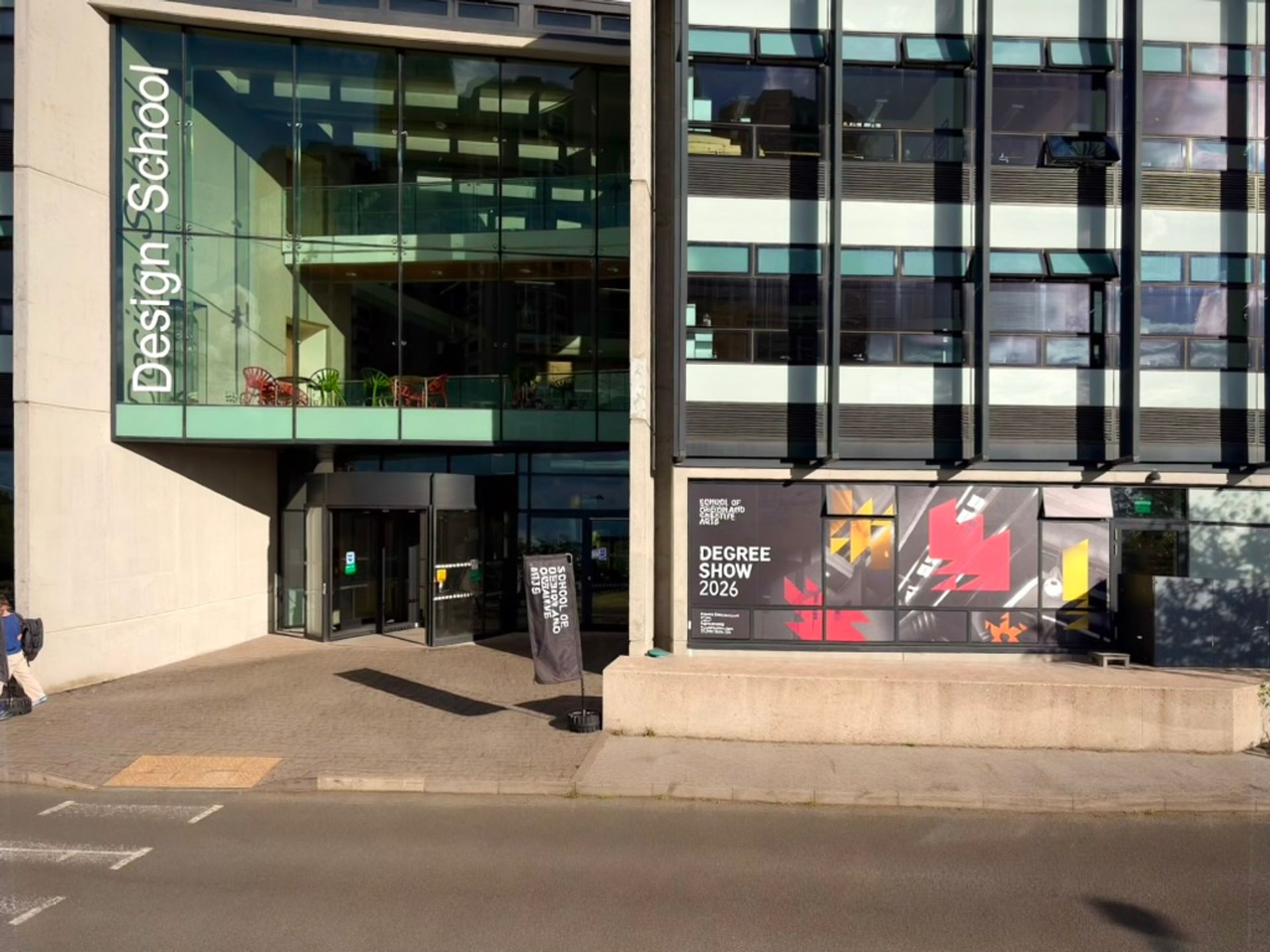
Two risks one runs when moving into a niche professional domain is detachment from the on-the-ground reality of undergraduate education and stagnation as you leave the hotbed of innovation that is a motivated and diverse student body. It’s always a delight visiting any exhibition of forward-looking final year projects; this year’s Degree Show at Loughborough was no exception. The following, as is most content in this blog, are expressly my own opinions and views.
Before I break down what was on offer through my lens, I think it is most important to acknowledge the feat that is completing three or more years of study and design practice at any fast-paced design school like Loughborough’s. Pulling through the thorough schemes of work and propelling a final year project to its concluding deliverable takes discipline, grit, and fortitude, no matter how passionate one is.
I will admit, I did not explore a major portion of the projects on offer - aside from professional directives, I was looking out for projects in my own domain and particularly exceptional displays of skill/taste. Amongst a strong showing, what separated the wheat from the chaff was a strong reason for being, well-informed design exploration, and purposeful investigation/development. Ultimately, needless to say, the final outcome carries substantial weight.
I had a wonderful time speaking to the to-be graduates about their journeys, struggles, and ‘Eureka’ moments. There was a palpable energy in the rooms of each of the three PD courses. I was also keen to hear how the proliferation and improvement of generative AI technology has impacted the course of their projects. There were responses that pointed to the obvious uses: speeding up visualisation work with Nano Banana and Vizcom. Writing code for embedded systems projects became easier, even if the wiring process did not receive the same boon.
One student spoke to me in great depth about their journey in electronics using ChatGPT/Codex. What initially began as a novice’s attempt to reach a working electronic prototype as quickly as possible started to unfold into a learning opportunity. Seeing small successes - individual sensors and outputs working one by one - as the AI tool wrote code, the student felt compelled to understand the code that was being written. He used ChatGPT to explain the generated code and was able to ask further questions where something was unclear. It was akin to having an interview with the developer who made the functionality possible. Repeating this process as his Arduino sketch became more fleshed out, he eventually reached the point of being able to write lines of code independently to build the functionality he needed for his prototype. A remarkable feat for just a few weeks’ work.
Another observation that revealed itself with greater clarity than ever before ties in to a post by Brad Harper I vividly remember reading the summer following my own graduation. I will reference it later on in this post.
“So much is made that I don’t think deserves to be made because resources are precious.” - Sir Jony Ive
A milder sentiment might be felt for products on display at various shows, conferences, and exhibitions: so much is made bespoke and proprietary that does not need to be. If you have just picked your pitchfork up, please do read till the end as I promise to justify the creation and form of these products through a different lens further down.
To illustrate my point with an example, imagine a device that allows for short-circuit malfunction detection of components on a PCB through thermal imaging. This could be combined with a feed from a regular camera and machine vision to identify the malfunctioning component (with or without being fed a layout schematic - I don’t know - this is just an improvised concept).
One could bundle these sensors into a handheld device, paired with a USB port and a rechargeable lithium battery, wrap it in an ergonomic and pretty casing, and call this a finished concept. And taken further, this may well represent a successful final year design outcome. There is room for exploration of user interaction and requirements, ergonomics and anthropometrics, and CMF.
My issue with this sort of product is that I do not think it fundamentally deserves to be its own bespoke hardware. Lest we forget: building something in hardware is costly - there is significant monetary, environmental, temporal, and effort cost associated with producing and bringing a hardware product to market. Unless a compelling argument exists for why this cannot be done with existing hardware, I do not think the environmental cost alone is justified.
In this example, I imagine the functionality can be achieved with a smartphone app and a thermal camera module, like the Flir camera (I do not know if the Flir specifically allows other apps to access its feed, but the point still stands). From a business standpoint, this makes much more sense, too. Why invest all of the resources to making hardware (which has much lower margins than software) when shipping software alone will achieve the same result and does not compromise the moat?
Unfortunately, if a student were to propose an iPhone app and Flir combination for solving their user’s needs, they would not score very highly on the assessment rubric. The scheme of assessment is formulated around the premise of a physical product (invariably in 2026, a technology product). By designing and producing the leanest offering that meets users’ needs, one would leave a fair portion of marks on the table: any physical user interaction testing, DfM considerations and analysis, part and assembly views, BoM, CMF, and mechanical analysis/FEA (if applicable) would all be absent.
Thus it seems that the design scheme of assessment has forced the hand of many of its own students, pushing into creation that which need not be created. And this is not explicitly the fault of those who write the assessment criteria; they, like all design educators, find themselves pulled apart in a tug of war between two opposing directives:
a) students need scaffolding and structure around which to complete their work - this is how we guide students to design success. The nature of teaching material is that to a large extent, this cannot be bespoke - it must be one-size-fits-all.
b) the design process, no matter how formalised, is inherently organic and must be carried out according to the needs of the problem and product. Not every product will need every UCD tool carried out. Not every product requires every step of the documentation for delivery to be completed (see above re. leaving marks on the table).
To wrap this post to as best a satisfying conclusion as I can write: my advice for those embarking on final year design studies is as follows and is based on a 2024 post from Brad Harper of Design Truth, lived experience, and countless conversations with those in the field:
- Keep the project ambition in check. As noble as it is to attempt to design a product that revolutionises a community or society, save that brief for after graduation. It matters more that your problem is easily digestible and universally understood by the layperson.
- To that effect, just like the MAYA principle provides boundaries for the innovation level a market is prepared for, there is a fine band for novelty/innovation/nicheness that tutors will accept. Too novel or ‘out there’ and your tutor will simply not understand what they are looking at. Not novel enough and you risk wasting your talent as an innovator. I suppose this could be called MNYA - pronounced like the comedian maybe? You would be surprised how far towards the conservative end of the scale this acceptable band is skewed; playing it safe really is the wise choice here.
- Go through the rigmarole of designing hardware. Play ball with the assessment objectives, even if they seem partially counterproductive. Once again: your chance to build this the way it should really be built is after graduation (and if you believe in solving your highlighted problem, then you absolutely should pursue this).
- Relating to the above: if attainment is your goal, suppress your entrepreneurial sensibilities. If an exercise seems asinine or wasteful from a business perspective, ignore your instinct for now until you are rid of the rubric. Unfortunately, the rules of investors and markets differ from those in the educational sandbox.
I hope this does not read as cynically as it might appear on the surface. This piece is in no way a sleight to any design finalists of their projects. It is an attempt at making visible the usually invisible rules of the game.
Till the next one
- Yuvraj